OEM vs Aftermarket Vacuum Kits: True TCO Guide
By Priya Rao • 3rd Mar
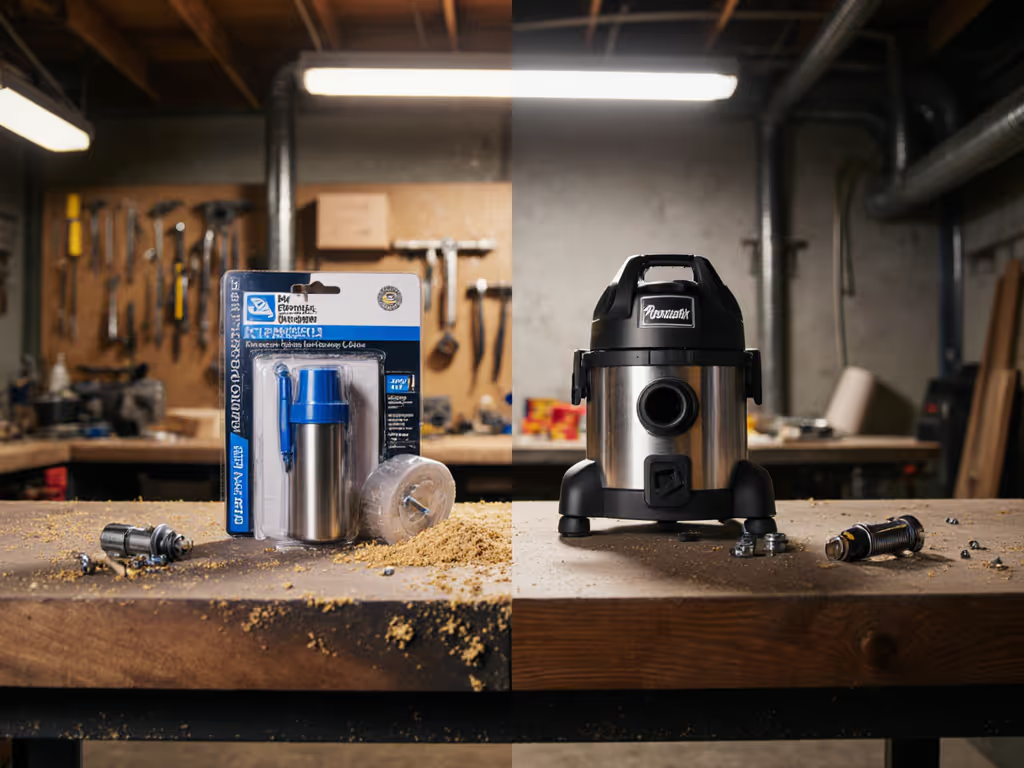
When you're standing in front of two vacuum kits (one OEM, one aftermarket), the sticker shock is real. The off-brand kit costs 40-60% less. So why would any contractor or facility manager pay more?
Because downtime bills you twice.
I've spent years budgeting for fleets and crews, and I've learned that vacuum accessory value comparison comes down to one number: total cost of ownership. If you're weighing power sources across a crew, see our cordless vs corded fleet TCO. That means initial price plus consumables, maintenance intervals, downtime, and callbacks, all tallied across the life of the equipment. This guide walks you through the questions you should be asking, the math you need to do, and how to spot which kit will actually save you money on the job.
FAQ Section: Understanding the OEM vs Aftermarket Split
Why does an OEM vacuum kit cost so much more upfront?
OEM (original equipment manufacturer) kits are engineered to exact specifications for your pump or vacuum model. That means precision-molded filter seals, matched hose diameters, proper material density for your dust type, and support documentation if something fails.
Aftermarket kits, by contrast, are designed to be "good enough" for multiple machines across different brands. Manufacturers cut costs by using thinner materials, softer plastics, and looser tolerances. The plastic on a generic filter may feel softer with more give; the sponge may be noticeably less dense. A third-party brushroll or belt may look identical but introduce gaps or wear unevenly.
That upfront savings? It comes from corners cut in engineering, testing, and materials, not from a better supply chain.
What happens when I use aftermarket parts on an OEM vacuum?
First, your warranty is void. The manufacturer won't support you if things go wrong.
Second, you lose the ecosystem. OEM kits include the right mix of parts tested together. You get the filter density matched to the motor's airflow, the hose diameter optimized for your tool port, the gaskets and seals engineered to hold vacuum without leaks. When you buy a bargain aftermarket kit, you're buying components that were never tested together for your specific machine.
Third, integration fails. A generic side brush designed for five different models may be too long for yours, leaving it unusable on carpeted surfaces. A lower-density sponge filter won't trap fine drywall dust as effectively, leading to motor bypass and shortened filter life. A loose belt design may slip under load or rattle during use.
How much longer does an OEM-maintained pump or vacuum actually last?
Becker pumps maintained with original parts typically achieve 10-15 years or more of normal operation. Industrial reports confirm this across brands: well-maintained machines hit design lifespan.
Pumps using aftermarket parts experience reduced lifespans, often cutting operational life by 20-40% compared to OEM-maintained equipment. The cause is consistent: mismatched specifications and inferior materials accelerate wear on every internal component, not just the replaced part.
Think of it like this: a cheap vane in an air compressor doesn't just wear faster, it also introduces clearance issues that wear the cylinder bore. One corner cut compounds into cascading failures.
The Math: Cost-Per-Job and Cost-Per-Hour
What does "total cost of ownership" actually mean for vacuum kits?
TCO is the sum of:
- Initial kit cost
- Filter/bag replacement frequency and cost per cycle
- Labor time for maintenance and troubleshooting
- Downtime (lost billable hours when the vac fails or loses suction)
- Replacement frequency (how often you buy a new kit or rebuild the machine)
- Warranty or support costs if things break
Let me walk through a real example. Assume you buy a vacuum system and kit for drywall work, running 5 hours per job, 40 jobs per year (200 hours annually). Not sure which filter media to spec for drywall dust? Start with our foam vs paper vs HEPA.
Scenario A: OEM Kit
- Initial kit: $320
- Filter replacements: One per 20 hours of use = 10 filters/year × $28 = $280/year
- Maintenance labor (scheduled filter swaps, hose inspection): 10 minutes per filter swap × 10 swaps = 167 minutes/year ≈ 3 hours
- Downtime from clogging or seal failure: ~2 hours/year (rare with OEM seals)
- Annual cost: $320 ÷ 5 years (conservative lifespan, spread) + $280 + $30 (labor at $10/hour shop rate) + $80 (downtime at $40/billable hour) = $174/year in kit and maintenance costs, plus minimal callbacks
Scenario B: Aftermarket Kit
- Initial kit: $180
- Filter replacements: One per 12 hours due to thinner material and poor sealing = 17 filters/year × $14 = $238/year
- Maintenance labor: 17 filter swaps × 10 minutes = 283 minutes/year ≈ 4.7 hours
- Downtime from clogging, seal leaks, or part failure: ~8 hours/year (loose seals, premature wear)
- Callback/diagnostic trips: ~1 per 6 months = 2 trips × 1.5 hours = 3 hours
- Equipment replacement due to accelerated wear: Replace kit every 2-3 years instead of 5 = $180 ÷ 2.5 years
- Annual cost: $72 + $238 + $47 (labor) + $320 (downtime + callbacks) + $15 (extra trips) = $692/year in visible and hidden costs, plus reputation risk
Over five years: OEM scenario ≈ $870 total. Aftermarket scenario ≈ $3,460 total. The OEM kit saves you roughly $2,590 in hard costs before accounting for callbacks that damage client trust.
This is why I always translate consumables into per-job math: OEM runs about $4.35 per drywall job in kit and filter costs; aftermarket runs $14.70 per job plus downtime exposure. The choice looks very different when it's framed that way.
How do I calculate cost-per-use if I don't know my maintenance interval?
Start with what the OEM specifies. A filter rated for "20 hours of use" or "replace when suction drops" needs a trigger. Don't wait for failure; schedule filter changes at half the rated interval if you're working with fine dust (drywall, concrete, plaster). That's your safe interval.
Then count:
- How many jobs per year, and how many hours per job?
- Divide total hours by filter interval to get filters per year.
- Multiply filters per year by cost per filter.
- Add 10-15 minutes per filter swap (labor cost) if your crew does it on-site.
- Estimate downtime: If a clogged filter causes you to lose an hour, what's that hour worth? For a solo contractor, maybe $40-60. For a crew, more.
- Divide total by jobs or hours to get cost-per-use.
This math is transparent, and you can tweak the assumptions. If you run a filter longer because you add a pre-separator, recalculate. If you use a cheaper filter and see callbacks spike, recalculate. That's the point: assume nothing.
Durability, Testing, and Compatibility Verification
How do I know if an aftermarket kit is actually compatible with my tools?
Don't rely on "works with" claims. Here's what to verify: For a brand-by-brand overview of adapter fit and cross-brand accessories, see our OEM vs generic accessories.
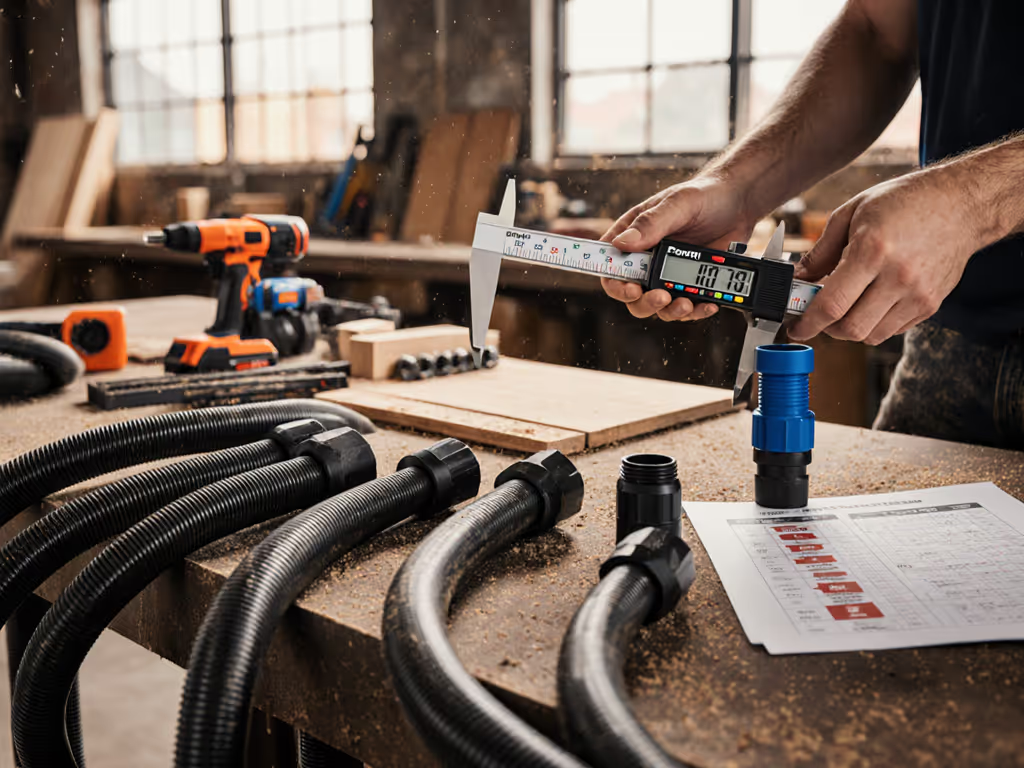
- Hose diameter: Measure your tool port in millimeters or inches (common are 27 mm, 35 mm, 1-1/4", 1-7/8", 2-1/2"). Does the aftermarket kit's hose match? A loose fit leaks air and kills suction—see hose length and diameter effects for why.
- Connection type: Is it a threaded port, a quick-disconnect, a bayonet? Generic kits often use rubber adapters that slip and loosen over time.
- Filter media and density: For drywall, you need pleated polyester or HEPA, not open-cell foam. Aftermarket sponges are often too loose and let fine particles bypass.
- Seal integrity: OEM gaskets and seals are molded to match your filter body. Aftermarket gaskets may be cut from sheet rubber, leading to air leaks.
- Pressure rating: Some vacuums are rated for 80 inches of water lift; others for 120+. A kit designed for general use may not handle the suction your sealed system produces.
The safest move: Buy the OEM kit, or cross-reference the aftermarket kit's part number against your equipment's manual. If the manual doesn't mention it, don't buy it.
What do durability testing results actually tell us?
OEM kits go through real-world stress tests: pressure cycling (vacuum on/off), dust loading (running until the filter clogs), moisture exposure, and thermal cycling. OEM manufacturers publish filter change intervals and efficiency curves based on this data.
Third-party vendors rarely publish the same testing. That gap matters. A filter that claims "works with Shop-Vac" but was never cycled through 100 hours of drywall dust won't have the same track record.
When you see an aftermarket product advertised as "OEM quality," ask for the test report. If there isn't one, treat it as unproven. Unproven equipment on a paying job is a liability.
Warranty and Support: The Hidden Cost of Going Cheap
What does it mean if my warranty is void?
It means the pump or vac manufacturer won't repair or replace the machine if something fails, even if the failure isn't directly caused by the aftermarket part. Wear and tear, corrosion, contamination, all fall outside coverage once you've used non-OEM components.
For a contractor running a $1,200 wet/dry vac, a voided warranty is a $1,200 risk. A simple motor seal failure could happen regardless of parts quality, but with OEM support, you'd get a replacement or subsidized repair. With aftermarket components, you pay full freight.
What kind of support do I actually get with OEM kits?
You get a parts department that knows your exact model, a technical team that can advise on which filter for which dust type, and documentation showing proper maintenance intervals. If a seal fails unexpectedly, you have a claim. If you order the wrong part, the supplier can catch that before you leave the counter.
With aftermarket kits, you're on your own. The seller may not even respond to technical questions. You're relying on user reviews and trial-and-error.
Actionable Steps: Building Your Kit Decision
Here's what I do when a crew asks me to approve a new vacuum kit for a job:
- Identify the mess: Drywall dust, concrete, water, plaster, soot, each requires a different filter and maintenance plan.
- Match the equipment: What sander, grinder, or tool will connect? Get the exact port size and connection type.
- Calculate the maintenance cost: How often will the filter clog? What's the cost per cycle? What's the downtime risk if suction drops mid-job?
- Compare TCO, not initial price: Add up five-year costs. If OEM is $900 and aftermarket is $600 initial but $2,200 total, the choice is clear. If you're deciding between pre-packed kits and piecemeal accessories, our starter kit value guide shows when bundles actually save money.
- Verify compatibility in writing: Don't rely on seller claims. Cross-reference the manual and take photos of the port connection before you buy.
- Factor in warranty: What's the cost of a voided warranty in your business? If you're a one-person shop relying on that vac, the risk is higher.
- Build a consumables roadmap: Know when filters need to be ordered, when maintenance is due, and what the SKUs are. Stock a backup filter. Nothing disrupts a job faster than discovering mid-day that filters are discontinued.
Pay once for uptime; pay forever for clogs and callbacks. That's not a slogan, it's the arithmetic of maintenance.
The kits you buy today will either free up labor and time, or consume both. The difference isn't brand loyalty. It's engineering, testing, and a transparent cost structure you can defend to yourself and your crew.
Related Articles