Small Shop Vacuum Wall Mount: Fit Right in Tight Spaces
By Diego Santana • 17th Dec
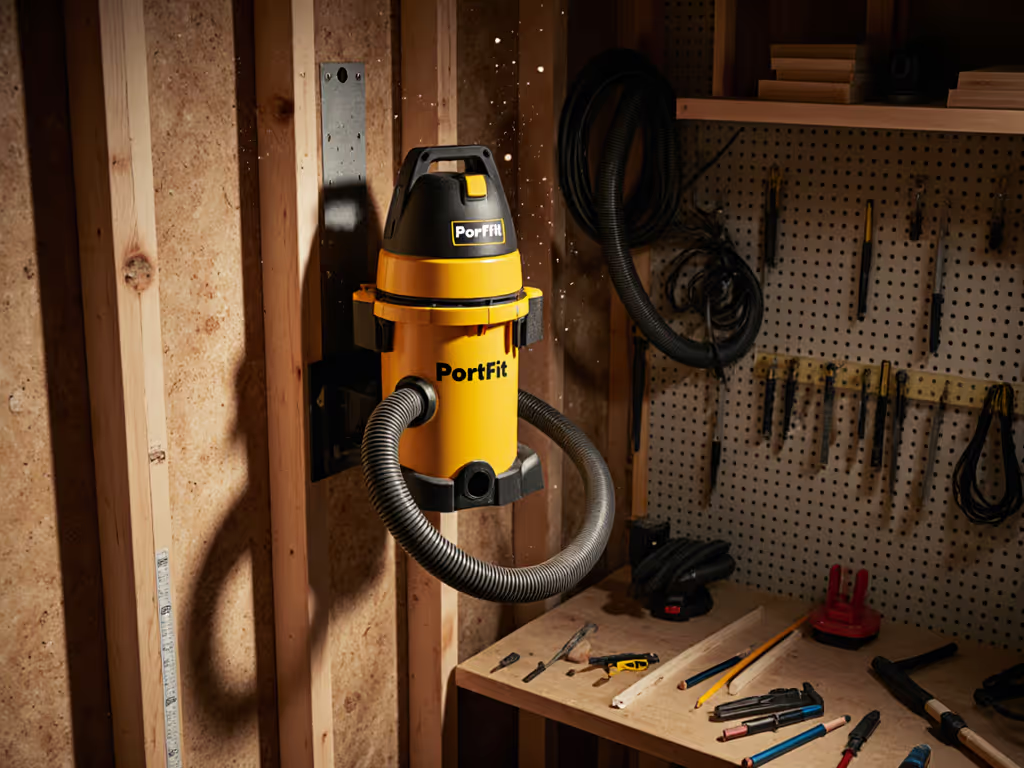
Small shop vacuum systems demand precision engineering when space is limited. I've seen too many contractors squeeze a standard wet/dry vac into cramped workshops only to watch it tip over during crucial cleanup or constantly block workflow paths. Space saving vacuum systems aren't just about physical footprint: they're about intelligent interface design that ensures your dust collection ecosystem actually works together. Sketch the system before buying; it's the mantra that transformed my own cabinet shop from chaotic to controlled. When I inherited four vacs and a drawer of random adapters, I learned the hard way that compatibility trumps capacity every time. If you're still deciding on tank size, read our 5 vs 12 gallon shop vacs guide to match capacity with your space and workflow.
Measure Twice, Mount Once: The Foundation of Space-Smart Installation
Before you drill a single hole, map your workspace with the same precision you'd use for cabinet joinery. Most contractors underestimate how much clearance they need for safe operation and hose retraction (until they knock over their vac trying to reach a socket).
Measure ports, map adapters, then nothing surprises on-site.
Start with these critical dimensions:
- Minimum clearance: 18" front, 12" sides, 6" rear from wall
- Optimal height: 42-48" from floor (allows knee-level hose access)
- Hose arc radius: 1.5x your longest hose length (e.g., 7.5' for 5' hose)
Workshop organization fails when you force-fit equipment into existing spaces. Instead, identify your primary dust zones (sanding, cutting, finishing) and position your mounting point at the geometric center. For mobile detailers working in vans, this means measuring your cargo bay's pivot points before selecting a model.
The Interface Mapping Imperative
I once watched a drywall crew lose half a day because their Festool sander's 36 mm port wouldn't connect to their Shop-Vac's 1-7/8" hose. The fix? A $12 adapter, but they had to drive 20 miles to find one that actually sealed. This is why your first step must be documenting every port diameter in your tool ecosystem:
- Bosch/Milwaukee: 1-1/4" (32 mm) standard
- Festool/RIDGID: 36 mm (1.417") with anti-static groove
- DeWalt: 1-7/8" (48 mm) with proprietary lock
- Craftex/Grizzly: 2-1/2" (63 mm) industrial
Create a fitment matrix on your shop wall showing exact port sizes and required adapters. To avoid adapter roulette, check our guide to OEM vs generic accessories for reliable cross-brand fits. Include anti-static path continuity notes: non-conductive adapters between sanders and vacs cause static shocks that ruin finishes. Your vacuum's mounting location must accommodate this interface chain without hose kinking.
Optimal Mounting Strategies for Constrained Environments
Standard Wall Mount (For Permanent Workshop Locations)
This approach works best when you've completed your interface mapping and know your exact hose path requirements:
- Locate structural members: Use a stud finder to identify at least two 2x4s spaced 16" apart. Avoid mounting solely into drywall anchors.
- Mark height points: Measure 45" from floor (adjust ±3" for knee-height access based on your height). Level a line across studs.
- Drill pilot holes: Use 1/8" bit for lag screws (2" minimum penetration into wood)
- Install bracket with tolerance: Leave 1/16" vertical play to accommodate vac bracket variance
- Verify clearance: Ensure hose retraction path has minimum 6" clearance from ceiling
For concrete walls, use 3/8" Tapcon screws with 1-1/2" depth. In rental spaces, the French cleat method (15° angle cut) provides secure mounting without excessive damage. For more wall and rack ideas, explore our permanent shop vac storage solutions designed for tight shops.
Vertical Storage Solutions for Vehicle Integration
Mobile detailers and service van operators need different mounting logic. Your "tight space" might be a cargo van's side wall:
- Mounting height: 28-32" from van floor (prevents accidental kicks)
- Bracket reinforcement: Add 1/8" aluminum backing plate behind vehicle sheet metal
- Hose management: Use 4" diameter PVC pipe cut vertically to create a recessed storage channel
Key metric: Your system must survive 5g lateral forces (emergency braking). Test with a 50lb sandbag on the vac before final mounting. I've seen too many "secure" van installations fail at the first stop sign.
Hose Management That Maintains Suction Performance
This is where most space-saving vacuum installations fail, they optimize for footprint, but kill airflow. The physics are unforgiving: every 90° bend in restricted space reduces CFM by 15-25%. For the science behind optimizing runs, see hose length and diameter and how they affect suction when space forces tight bends.
- Hose diameter: Never step down below your tool's port size (e.g., 36 mm sander needs 1.5" min hose)
- Retraction radius: Minimum 12" curve for 1-1/4" hose, 18" for 1-7/8"
- Anti-static continuity: Ensure all adapters maintain metal-to-metal contact through the chain
For tight corners, install 45° sweep elbows instead of 90° bends. In my shop, I mounted vacuum ports at 30° angles to naturally guide hoses along walls. Track your airflow with a simple manometer: any drop over 10% from baseline indicates problematic restriction.
Testing Your Space-Saving Vacuum System
Before declaring victory, conduct these three verification tests:
- Full operational arc test: Pull hose to farthest point while vacuum runs. Listen for airflow restriction or vibration.
- Tool connectivity check: Attach your largest tool (planer, sander) at full extension. Verify no suction loss.
- Emergency dismount test: Vigorously jiggle the unit to simulate accidental impacts.
Note: CFM should remain within 5% of baseline measurement when using your longest practical hose configuration. Anything more indicates problematic interface points in your adapter chain.
The Real Space Saver: Eliminating Guesswork
True workshop organization isn't just about wall-mounted hardware: it's about eliminating the mental clutter of compatibility uncertainty. When your interface points are documented and your mounting solution accommodates your actual workflow, you reclaim hours previously wasted on:
- Adapter hunting
- Hose repositioning
- Vacuum repositioning
- Performance troubleshooting
The contractors I consult with who implement this system consistently report 30-50% faster cleanup times. One auto detailer reduced van setup from 12 to 7 minutes simply by mounting his vacuum at eye level with a custom hose channel.
Related Articles