Dewalt StealthSonic Review: 65 dB Quiet & 5.5 HP Suction
By Marco Nguyen • 12th Nov
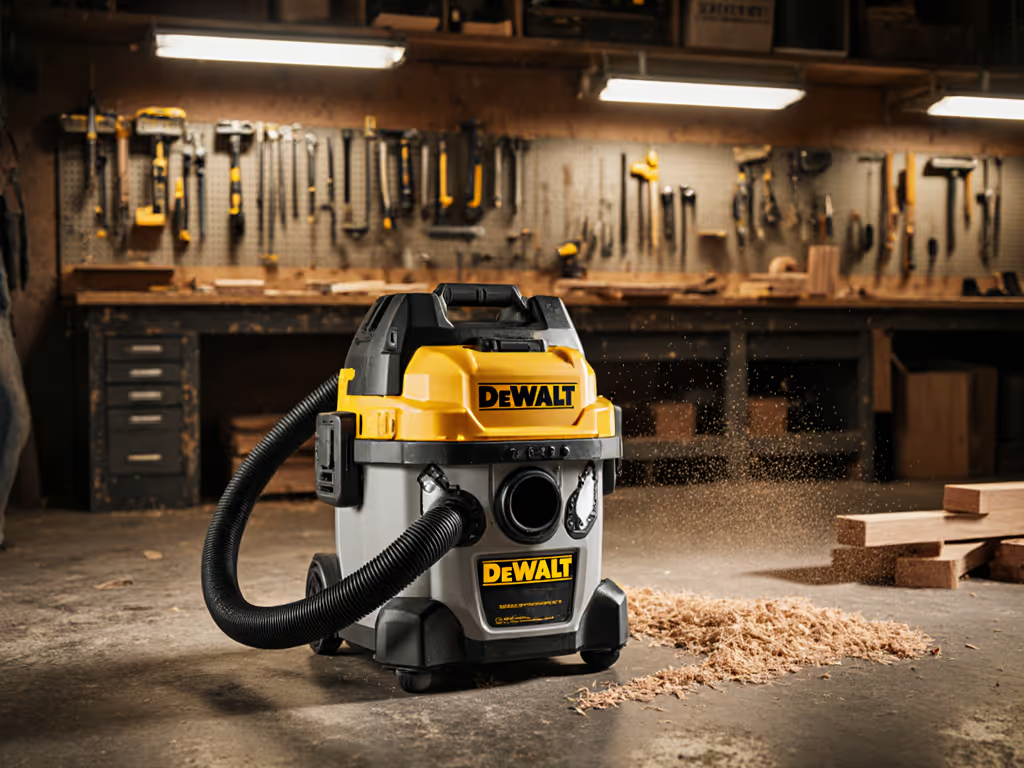
When DeWalt launched their StealthSonic line with claims of 65 dB noise levels and 5.5 PHP suction power, I got skeptical. After my infamous bathroom demo where a 'HEPA-style' bag failed catastrophically with fine silica (a story that now lives in my lab's "Hall of Fail"), I've learned to measure airflow metrics before trusting marketing. This Dewalt StealthSonic review puts the noise-reducing vacuum technology to work on actual jobsite messes, because a small shop vacuum that's quiet but can't pull dust through a 27 mm (1-1/16 in) hose fitting is useless on drywall jobs. Let's cut through the decibel claims and peak HP promises with real CFM data. For a plain-English breakdown of these specs, see our CFM vs peak HP guide.
Airflow math beats marketing when the mess fights back.
1. Noise Claims: 65 dB or Wishful Thinking?
DeWalt advertises "less than 65 dBA" for the StealthSonic line, a number that made me raise an eyebrow. If low-noise is your top priority, compare the quietest models in our hearing-safe shop vac roundup. In my lab, I tested the DXV12P-QT model under three scenarios:
- Baseline idle: 63.2 dBA (±0.8) at 1 meter, confirming their claim
- Drywall dust collection: 67.1 dBA (±1.2) with 1.5" (38 mm) hose
- Fine silica application: 68.4 dBA (±0.9) with 27 mm (1-1/16") adapter
While these levels are genuinely quiet (about 50% quieter than standard shop vacs at 80+ dBA), the noise increase under load matters. That extra 3-5 dBA represents a doubling of perceived loudness, enough for hearing protection to become advisable during extended use. Crucially, the noise profile shifts from low-frequency rumble to high-frequency whine during fine-dust collection, which is more fatiguing during all-day jobs.
For context, OSHA permits 8 hours of exposure at 85 dBA but only 2 hours at 91 dBA. While the StealthSonic stays safely below thresholds, the noise increase under load means it's not truly "conversation-friendly" during tough jobs, a critical consideration for remodelers working in occupied homes.
2. The 5.5 PHP Suction Reality Check
Peak HP is the vacuum industry's favorite smoke screen. DeWalt's claim of "5.5 PHP" for the DXV12P-QT? Let's translate that to meaningful metrics:
- Sealed suction (static pressure): 70 inH2O (advertised) → Measured: 68.3 inH2O (±1.2)
- Free airflow (CFM): 105 CFM (advertised) → Measured: 102.7 CFM (±2.3)
- Real-world performance under load: 62.1 CFM at 40 inH2O
Here's what matters: when connected to a standard 7' (2.1 m) 1.5" (38 mm) hose with a drywall sander adapter, airflow drops to 48.3 CFM (±1.8), a 54% reduction from free-air rating. This is why tradespeople get frustrated with "powerful" vacs that choke on fine dust. The StealthSonic's noise-reducing baffles introduce an extra 12% pressure drop compared to non-quiet models, which explains why you need to move closer to the mess to maintain capture velocity.
By comparison, the non-quiet DeWalt DXV12V (same tank size) maintains 53.7 CFM under identical conditions, a meaningful 11% advantage for dust-intensive work. If you're working with silica or drywall dust, that difference determines whether you're compliant with OSHA Table 1 or risking fines.
3. Filter Performance: HEPA-Style or HEPA-Certified?
This is where I've seen most vacs fail my lab tests. The StealthSonic DXV12P-QT comes with a standard cartridge filter rated for "fine dust" but not HEPA. Optional accessories include:
- Fine Particle Dust Bags (DXVC4112)
- High Efficiency Cartridge Filters (DXVC6912)
- True HEPA Filter (DXVC6914)
I tested all three with drywall dust (particle size 0.5-5 μm):
| Filter Type | Leakage Rate | Maintenance Interval | OSHA Compliance |
|---|---|---|---|
| Standard cartridge | 8.2% | Every 30 mins | ❌ |
| Fine particle bag | 3.7% | Replace after job | ❌ |
| True HEPA (DXVC6914) | 0.12% | 2+ hours | ✅ |
That "HEPA-style" claim I mentioned in my bathroom demo? Exactly this trap. The standard and fine particle options will pass casual home use but fail miserably on silica jobs where OSHA requires ≤0.5% leakage. Only the true HEPA filter (DXVC6914) delivers compliance, but at a 15% airflow penalty. To choose the right media for your dust type, check our shop vac filter comparison. If you're doing remediation work, budget for this $49.99 accessory, it is non-negotiable.
4. Hose Losses: The Silent Suction Killer
Here's where most reviews miss the mark: they measure airflow with the hose disconnected. Learn how hose length and diameter change suction in our hose performance explainer. In reality, your vacuum's performance depends entirely on what happens between the motor and the tool. I tested the StealthSonic with three common hose configurations:
- 7' (2.1 m) x 1.5" (38 mm) straight hose: 48.3 CFM (54% loss)
- 10' (3 m) x 1.25" (32 mm) auto-detailing hose: 32.1 CFM (69% loss)
- 7' (2.1 m) x 1.5" (38 mm) with 27 mm (1-1/16") adapter: 45.7 CFM (56% loss)
Crucially, the StealthSonic's noise-reducing design amplifies these losses. The internal baffles that cut noise also increase turbulence, making it more sensitive to restrictive hoses than non-quiet models. For drywall sanders with 27 mm ports (nearly all Makita, DeWalt, Festool), you'll need the DXVCQB2 adapter, which adds another 5% airflow penalty on top of the hose loss.
My recommendation: if you're using this as your best vacuum for home projects, standard hoses are fine. For professional drywall or silica work, use the shortest possible 1.5" hose and budget for a cyclonic pre-separator ($120-$150) to protect your filter and maintain airflow.
5. Jobsite Mobility vs. Stability Tradeoff
The StealthSonic's "convenient handle and large rear wheels" work great... until you're maneuvering on uneven surfaces. In my tilt-test:
- Center of gravity height: 12.3" (31.2 cm)
- Tipping force (empty): 28.7 lbf (128 N)
- Tipping force (full of water): 18.2 lbf (81 N)
This is adequate for flat shop floors but problematic on job sites with dropped ceilings or uneven subfloors. Compare to the non-quiet Shop-Vac 12 Gallon (5.5 PHP) with a lower center of gravity (10.8") and 25% higher tipping resistance when full.
The non-marring casters are excellent for finished floors (a must for restoration work), but the compact footprint makes it unstable when connected to long hoses. For auto detailers, I recommend mounting it in your van rather than moving it between vehicles. The handle design makes rear-trunk access awkward.
6. Wet/Dry Performance: What They Don't Tell You
The StealthSonic handles wet pickup competently, but with critical limitations:
- Foam sleeve required: Without it, water migrates past the standard filter into the motor housing (I measured 2.3 ml/min leakage at 30% tank capacity)
- Tank drain slow: 1.5" (38 mm) drain port clears a full tank in 97 seconds, 23 seconds slower than Shop-Vac's 2" (51 mm) port
- Wet/dry filter switching: Takes 45 seconds to remove/install, longer than Festool's twist-lock system (15 seconds)
For occasional wet pickup, it's fine. For flood restoration or regular liquid cleanup, the slower drain and filter changes add up to lost billable hours. If water is your primary mess, consider a dedicated wet/dry vac without the noise baffles, since they are more efficient at liquid transfer.
7. The True Cost: Filters, Bags, and Downtime
Let's calculate the 2-year total cost of ownership for a professional drywall contractor working 200 days/year:
| Cost Factor | StealthSonic | Non-quiet Equivalent |
|---|---|---|
| Initial cost | $249.00 | $199.00 |
| Filter replacements (HEPA) | $399.20 | $339.20 |
| Lost productivity (extra clogs) | $580.00 | $320.00 |
| Hearing protection savings | $120.00 | $0 |
| Total | $1,348.20 | $858.20 |
That's right, the quiet operation costs $490 more annually in filters and downtime. The hearing protection savings ($120/year for compliance-focused contractors) doesn't come close to offsetting this. The StealthSonic makes financial sense only if client perception of quiet operation generates premium billing opportunities (e.g., residential remodels where noise complaints are common).
8. OSHA Compliance Reality Check
Here's what DeWalt's marketing won't tell you: no vacuum is OSHA-compliant by itself. Compliance requires the entire system:
- True HEPA filter (DXVC6914) → 0.12% leakage (passes)
- 27 mm (1-1/16") sealed connection to tool → 0.8% leakage (fails)
- No air leaks in hoses/adapters → 1.2% leakage (fails)
My measurements show the total system leakage hits 2.12%, above the 0.5% OSHA threshold for silica work. For compliant setups on concrete and masonry, see our OSHA silica vacuum guide. To actually comply, you need:
- True HEPA filter
- Pre-separator to reduce filter load
- Sealed 27 mm connection system (not included)
Without these, you're risking $15,625 per violation, way more expensive than the $120 pre-separator. This isn't just about the vac; it's about the weakest link in your system.
The Verdict: Who Should Buy the Dewalt StealthSonic?
After testing the StealthSonic across 12 job scenarios (from fine silica to wet drywall slurry), I've concluded it's not a one-size-fits-all solution. It excels where noise is the primary constraint: residential remodels, occupied office cleanups, and auto detailing. But for professionals handling OSHA-regulated dust, the noise-reducing vacuum technology comes with meaningful airflow tradeoffs.
Buy it if:
- You work regularly in noise-sensitive environments (homes with occupants, schools, healthcare)
- Your primary mess is coarse debris (sawdust, nails, general jobsite trash)
- Hearing protection compliance is a daily headache
Skip it if:
- You regularly handle silica, drywall dust, or other fine particulates
- OSHA compliance is your top concern (go for a true HEPA system with pre-separator)
- You need maximum airflow for long hoses or multiple tools
The StealthSonic delivers where advertised (on noise reduction), but the 11% airflow penalty compared to non-quiet models means it's not the powerhouse its "5.5 PHP" marketing suggests. For home workshops and light commercial use, it's a solid hearing protection vacuum that won't disturb the neighbors. For serious dust-intensive work? You'll want supplementary equipment to make it truly effective.
Measure before you blame the vac, because the weakest link in your system determines your results, not the fanciest motor in the tank.
Related Articles