5 Best Vacuums With HEPA Filters: Tested Sub-Micron Capture
By Priya Rao • 17th May
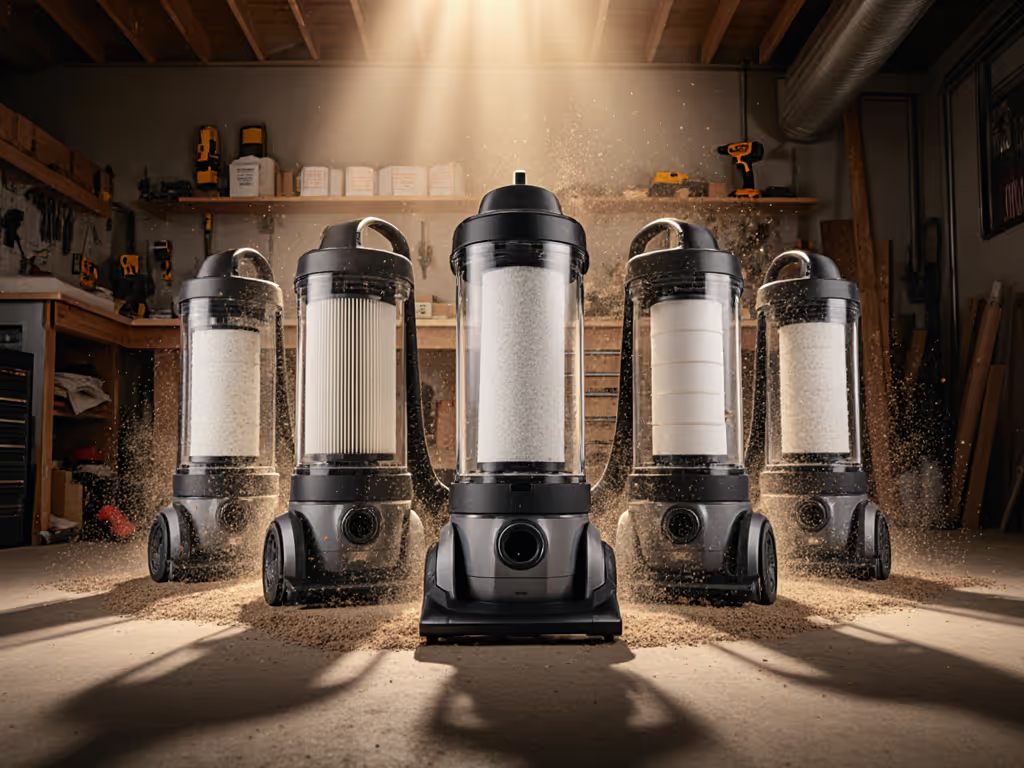
If you're trying to choose the best vacuum with HEPA filter for real-world work (dusty remodels, school hallways, detail bays, or medical offices), sticker specs don't tell you enough. You need HEPA performance tested in the real world, not just a "HEPA-style" label on a box that leaks at every seam.
Below are five HEPA-capable options that balance sub-micron filtration, uptime, and total cost of ownership. I'll translate their pros and cons into per-job, per-hour decisions so you know what will actually hold up on the job, not just on paper.
Downtime bills you twice: once in labor while the vac is apart, and again in callbacks when dust escapes.
What "Real HEPA" Actually Means on a Job Site
Before we rank anything, let's align on language. Not every vacuum with HEPA filter is a true HEPA system.
HEPA basics in plain English
- True HEPA standard: 99.97% capture at 0.3 microns (0.3 µm) (the "hardest to catch" particle size).
- Sub-micron filtration: means we're talking about particles below 1 micron (fine concrete dust, combustion particles, and a chunk of microbial particle capture such as bacteria, spores, and some droplet-bound viruses).
- A HEPA filter alone is not enough. You need:
- Sealed system (no bypass leaks around the filter)
- Correct gasket compression and latches
- Bags or pre-filters that don't tear or blow out when full
When manufacturers talk about HEPA performance tested, you're looking for one of:
- A stated HEPA class (e.g., H13/H14 in EN 1822 testing) or equivalent
- A claim like "sealed system, whole-vacuum HEPA tested" or "HEPA filtration of exhaust air, independently verified"
- For OSHA-silica applications, language like "MEETS OSHA TABLE 1 when used as directed" plus a HEPA filter part number
Bagged vs bagless for HEPA work
Bagless is attractive on price. But for heavy dust (drywall, cutting, sanding, concrete), a bagless HEPA unit can burn time on filter cleaning and bin decontamination.
With bagged HEPA systems, bags act as a pre-filter:
- The bag takes the abuse.
- The expensive HEPA filter loads slowly and lasts much longer.
- Disposal is less dusty (critical for silica/mold). For handling hazardous debris and used filters safely, see our vacuum filter disposal guide.
I've seen this play out on year-long projects: a "cheap" bagless looked good until we added lost hours from clogs and cleanup. Once we paired a HEPA bag with a good separator and scheduled filter changes, consumable costs rose slightly, but job hours dropped and the air stayed cleaner.
Pay once for uptime; pay forever for clogs and callbacks.
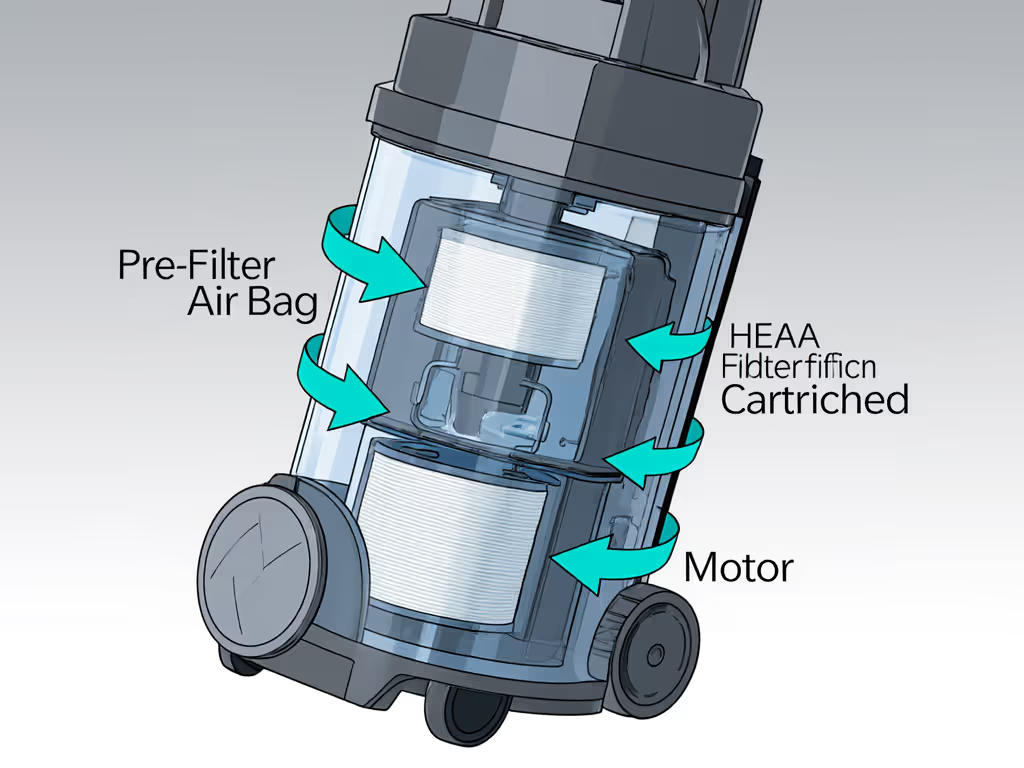
1. Best Overall: Sealed HEPA Bagged Canister (e.g., Miele Complete C3 Series)
For facilities, cleaning contractors, and serious homeowners who want quiet, genuine HEPA, and excellent sub-micron filtration in finished spaces, a sealed, bagged canister like the Miele Complete C3 with HEPA is a workhorse template.
Why it's on this list
- Sealed system with verified HEPA: Miele's AirClean system, when paired with their HEPA filter cartridges, is independently tested as a sealed system. This isn't just "HEPA media" - the whole machine is designed to avoid leaks.
- Bag-first filtration: Multi-layer bags catch most dust before it ever hits the HEPA filter. That keeps suction steady and extends HEPA life.
- Exceptional for occupied spaces: Low noise, smooth casters, and good tools make it ideal for schools, offices, medical suites, and post-remodel cleanup.
Uptime and cost math
Assume:
- HEPA filter: ~$60, replaced annually in routine facility use
- Bags: ~$4 each, 3-4 weeks per bag in daily light-moderate duty
- Use: 2 hours/day, 5 days/week ≈ 40 hours/month
If one bag lasts ~30-40 hours, that's roughly $0.10-$0.13/hour in bag cost. HEPA at $60/year over ~500 hours/year is ~$0.12/hour. Call it $0.25/hour for filtration hardware.
Compare that to losing 10 minutes/day shaking out filters and wiping dust off surfaces because of blow-by. At even $30/hour labor burden for a custodian, one extra dusty 10 minutes per day is ~$0.83/hour of run time over the month. The "cheaper" non-sealed vac costs more in labor and air quality.
Best for
- Schools, offices, clinics, higher-end residential
- Allergy- and asthma-sensitive spaces
- Post-construction cleaning where you're not sucking up chunks
Watch-outs
- Not a shop vac: not for slurry, nails, or big debris
- Hoses/tools are more "housekeeping" than "jobsite," not easily adapted to 1-1/4" or 1-7/8" tool ports without aftermarket adapters
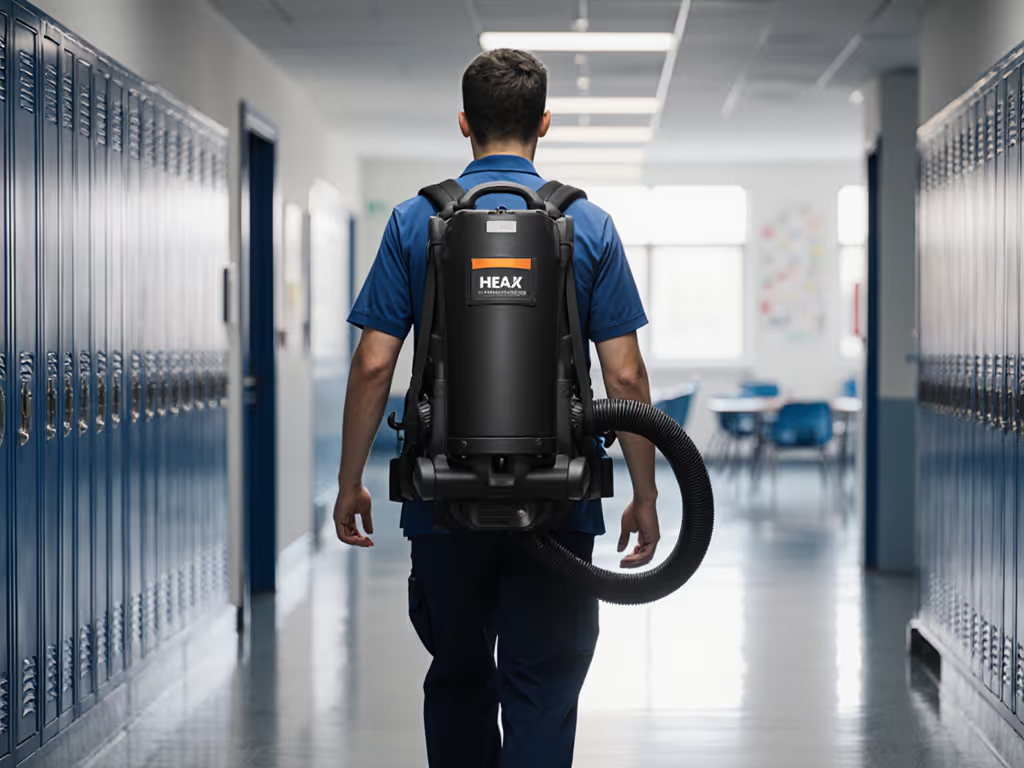
2. Best Commercial Backpack: HEPA Backpack for Large Facilities (e.g., ProTeam HEPA Models)
If you're maintaining large buildings (schools, hotels, campuses), a HEPA backpack vacuum with genuine, tested HEPA filtration is often the lowest cost per square foot cleaned.
Why it's on this list
- High productivity: Crews can move quickly without wrestling a canister. That's real money on clocked routes.
- Multi-stage sub-micron filtration:
- Cloth or synthetic inner bag
- Micro-filter (often a dome or disk)
- Final HEPA cartridge in the exhaust path
- Several backpack lines (such as ProTeam's HEPA-rated models) publish HEPA compliance verification data and are widely used in healthcare and education custodial programs.
Uptime and cost math
Example scenario for a mid-size facility team:
- Route: 20,000-30,000 sq ft nightly
- Vacuum run time: 3 hours/shift
- Inner bag: $5-$7, lasts 1-2 weeks/route depending on soil
- HEPA filter: $70-$100, often 1-2 years with good pre-filtration
At ~60 hours/month of run time, one bag every two weeks is ~2 bags/month ≈ $10-$14/month, or $0.17-$0.23/hour. HEPA at $80 every 18 months over ~1,000 hours is $0.05/hour.
Total filtration cost: ~$0.25/hour, with dramatically reduced airborne dust in stairwells, classrooms, and corridors.
Now compare to older non-HEPA uprights blowing fine dust back into the air, forcing extra dusting and making your IAQ reports look bad. That's where risk-adjusted ROI shows: fewer complaints, better test numbers, and less labor on redo work.
Best for
- Custodial teams in schools, universities, hotels, convention centers
- Healthcare common areas (always check your infection control requirements)
- Crews that need productivity + microbial particle capture from carpets and high-traffic floors
Watch-outs
- Training and fit matter: straps and harness need adjusting to avoid fatigue
- Not ideal for wet pickup or heavy construction dust
3. Best Cordless Stick: High-End HEPA Stick for Touch-Ups (e.g., Dyson V15 Detect)
Cordless sticks like the Dyson V15 Detect sit at the "premium" end of consumer vacs, but they're very useful in pro settings for fast, high-filtration touch-ups.
Why it's on this list
- Whole-machine HEPA filtration: The V15 series and similar premium sticks are designed so incoming air is filtered before exhaust, with seals to minimize leaks. Independent tests have shown excellent control of fine and sub-micron particles compared to many cheaper sticks.
- Fine dust specialist: Designed to pull fine dust out of hard floors and carpets, with cyclone stages in front of the HEPA to protect it.
- Cordless maneuverability: Great for:
- Quick cleanups in occupied homes after a dusty task
- Mobile auto detailing
- Stairs, condos, and tight apartments where dragging a canister is awkward
Uptime and cost math
Cordless sticks aren't your primary production vac; they're a time-saver for final detail work.
Suppose:
- You use it 20 minutes at the end of each job for final client-facing cleanup.
- You wash the HEPA and pre-filters every 2-4 weeks and replace HEPA annually.
A replacement HEPA assembly in this class may cost $40-$60/year. For runtime, charging, and battery health trade-offs, see our Li-ion vs NiMH comparison. If that supports ~200 jobs, that's $0.20-$0.30 per job for top-tier, tested HEPA performance at the last mile.
The real ROI: jobs that look and feel clean when you hand the keys back. That reduces callbacks and the "we'll just vacuum again quickly" unpaid visits.
Best for
- Remodelers and trades who want a separate, clean vac strictly for finished surfaces
- Auto detailers needing strong suction and sub-micron filtration in client interiors
- Facility teams that need a quiet, cordless option for daytime spot cleaning
Watch-outs
- Small bin: not for demolition dust or large debris
- Filters must be washed and dried completely; plan a rotation set to avoid downtime
- Runtime is limited; for heavy use, you'll want spare batteries
4. Best for Silica & Construction Dust: 10-14 Gallon HEPA Dust Extractor (OSHA-Focused)
For concrete grinding, tuckpointing, or heavy drywall sanding, you need more than a "vacuum with HEPA filter." You need a jobsite dust extractor with:
- Documented HEPA performance tested at the exhaust
- High CFM and water lift
- Often, an auto-filter-clean mechanism
- Clear statements about OSHA Table 1 compatibility when paired with specific tools
Several brands (Bosch, Hilti, Makita, DeWalt, Metabo, Fein, Festool, etc.) make 10-14 gallon HEPA dust extractors that meet these criteria. For trade-specific guidance on compliant setups, check our OSHA-compliant silica vacuums. The exact model is less important than the combination of performance + documentation.
What to look for
- Filtration stack
- Fleece or synthetic pre-filter bag
- Main filter rated for fine dust
- Final HEPA cartridge, often H13 or equivalent
- Airflow
- Enough CFM to match your tools (grinders, saws, sanders)
- Good sealed suction (water lift) for floor pickup and hoses up to 25-30 ft
- HEPA compliance verification
- Manual stating the HEPA filter part number
- Mention of 99.97% at 0.3 µm or equivalent testing
- For silica: references to OSHA compliance or Table 1
Uptime and cost math
Fine silica dust will choke a basic shop vac in minutes. A good dust extractor with bags and auto filter clean can run hours per day with consistent suction.
Example:
- Crew: 2 grinders on and off throughout the day
- Vac run time: ~4 hours/day
- Bag: $10-$15, lasts 2-3 days of heavy grinding dust
- HEPA: $120-$200, often 6-12 months in real use when bags are used religiously
Say a bag is $12 over ~10-12 hours = $1.00-$1.20/hour. HEPA at $160 over 800 hours = $0.20/hour. So roughly $1.20-$1.40/hour in consumables.
That sounds high until you compare:
- OSHA fine risk
- Labor lost when a cheap vac clogs and has to be opened and cleaned mid-pour
- Health costs and reputation damage from airborne silica
For concrete and drywall pros, this is the case where paying for true HEPA and auto-filter-clean is absolutely cheaper over the year.
Best for
- Concrete cutting and grinding
- Professional drywall sanding
- Masonry and tuckpointing
- Restoration/remediation where HEPA and containment are specified
Watch-outs
- Heavier and pricier than big-box wet/dry vacs
- You must use the specified bags and HEPA filters to retain compliance
- Hose/tool-port compatibility matters; budget for proper 27/36 mm or 1-3/8" adapters
5. Best Budget HEPA for Small Shops & Homes: Sealed Upright/Canister (e.g., Shark Lift-Away HEPA Models)
If you're on a tighter budget but still want strong microbial particle capture and good control of fine dust in homes or small shops, several sealed-system uprights and canisters hit a solid "good enough HEPA" level.
Shark's better Lift-Away models (such as Navigator or Apex variants that specifically advertise "Anti-Allergen Complete Seal + HEPA") are a good pattern to look for. Independent reviews and lab tests have shown these sealed uprights can come surprisingly close to premium brands on sub-micron filtration when properly maintained.
Why it's on this list
- Sealed system design: The better Shark models are built so that all exhaust passes through the HEPA; gaskets and plastic shells reduce bypass.
- Affordable: Often half to one-third the up-front cost of premium canisters.
- Versatile tools: Useful for carpet, hard floors, stairs, and furniture.
Uptime and cost math
Assume:
- HEPA filter + pre-filter pack: $25-$35/year for typical home/small-shop use
- No bags; you empty the bin frequently
If you run it ~150 hours/year (3 hours/week), your HEPA cost is roughly $0.17-$0.23/hour. Labor is where things swing:
- If you're emptying the bin outside and tapping filters out gently, allow 5 minutes every 3-4 hours of use.
- At a $40/hour billable rate, that's ~$0.80-$1.00/hour in labor just to keep suction decent.
Compare that to the bagged canister where bag changes are faster and much less dusty. This is where budget HEPA makes sense for lighter-duty, less frequent use, but not for all-day professional demolition dust.
Best for
- Small residential cleaning businesses
- DIYers with allergies/asthma who vacuum 2-4 times per week
- Light post-project cleanup where you're not sucking up heavy construction debris
Watch-outs
- Not designed for silica-heavy workloads
- More maintenance and filter-cleaning time than bagged systems
- Some models are louder than pro canisters; check dB ratings if you work in occupied spaces
How to Verify HEPA Claims Before You Spend a Dollar
Whatever you buy, you should be able to defend it to a client, inspector, or supervisor. If you're weighing filter media and maintenance trade-offs, see our shop vac filter comparison. Here's a quick HEPA compliance verification checklist you can use on any spec sheet or product page:
- Look for real numbers, not vague phrases
- "99.97% at 0.3 microns" or better
- "H13/H14 HEPA" or EN 1822 reference
- Check that it's the whole machine
- Phrases like "whole-machine HEPA" or "sealed system HEPA" are better than "HEPA-type filter."
- Manuals showing gasketed HEPA cartridges downstream of the motor are a good sign.
- Confirm filter part numbers
- There should be a specific HEPA filter SKU you can reorder.
- Replacement guides should specify intervals (hours or months) based on use.
- Ask: what's the path of the dust?
- Bag or bin → pre-filter → main filter → HEPA.
- Every joint in that path should latch or gasket tight.
- Match to your mess
- Silica, lead, mold, asbestos (where legal/specified): you need a certified HEPA system, often with written documentation.
- General allergies / indoor air quality: well-designed sealed HEPA is usually sufficient.
Once you've chosen, build a maintenance schedule:
- Bags: replace when ~75-80% full or when suction drops noticeably
- Pre-filters: clean weekly in heavy use; replace when damaged or permanently loaded
- HEPA filters: set calendar reminders (e.g., every 6-12 months) or hour-based triggers if your vac has a meter
This predictable schedule is the difference between "it had a HEPA sticker" and "our HEPA system is performing as tested."
Summary and Final Verdict
If we boil this list down to who should buy what, it looks like this:
- Sealed HEPA bagged canister (e.g., Miele C3) - Best overall for facilities and serious homeowners who want quiet, trusted sub-micron filtration and low mess on filter changes.
- HEPA backpack (e.g., ProTeam-style commercial units) - Best per-square-foot cost for large facilities (schools, hotels, campuses) where speed and IAQ both matter.
- Premium cordless stick (e.g., Dyson V15) - Best high-filtration finisher for trades and detailers who need spotless, low-dust results at handover.
- 10-14 gallon HEPA dust extractor - Best (and often mandatory) for silica and heavy construction dust where OSHA compliance and robust uptime are non-negotiable.
- Budget sealed HEPA upright/canister (e.g., Shark Lift-Away HEPA models) - Best for smaller budgets and lighter-duty work where you still want genuine HEPA-style containment.
If you're unsure where to start, ask yourself two questions:
- What's the worst dust I deal with regularly (silica, mold, fine drywall, or just general household dust)?
- How many hours per week will this vac actually run under load?
Match the vac to the worst dust and the real hours, then layer on:
- Sealed HEPA path with documented performance
- Bags or pre-filters appropriate to your mess
- A written filter/bag change schedule
Do that, and your HEPA system will perform at the level the tests promised, without wrecking your budget in surprise downtime.
Remember: Downtime bills you twice. Choose the vacuum that keeps suction stable, dust contained, and filters predictable, and the extra you pay upfront will come back to you in fewer clogs, fewer callbacks, and cleaner air wherever you work.
Related Articles